

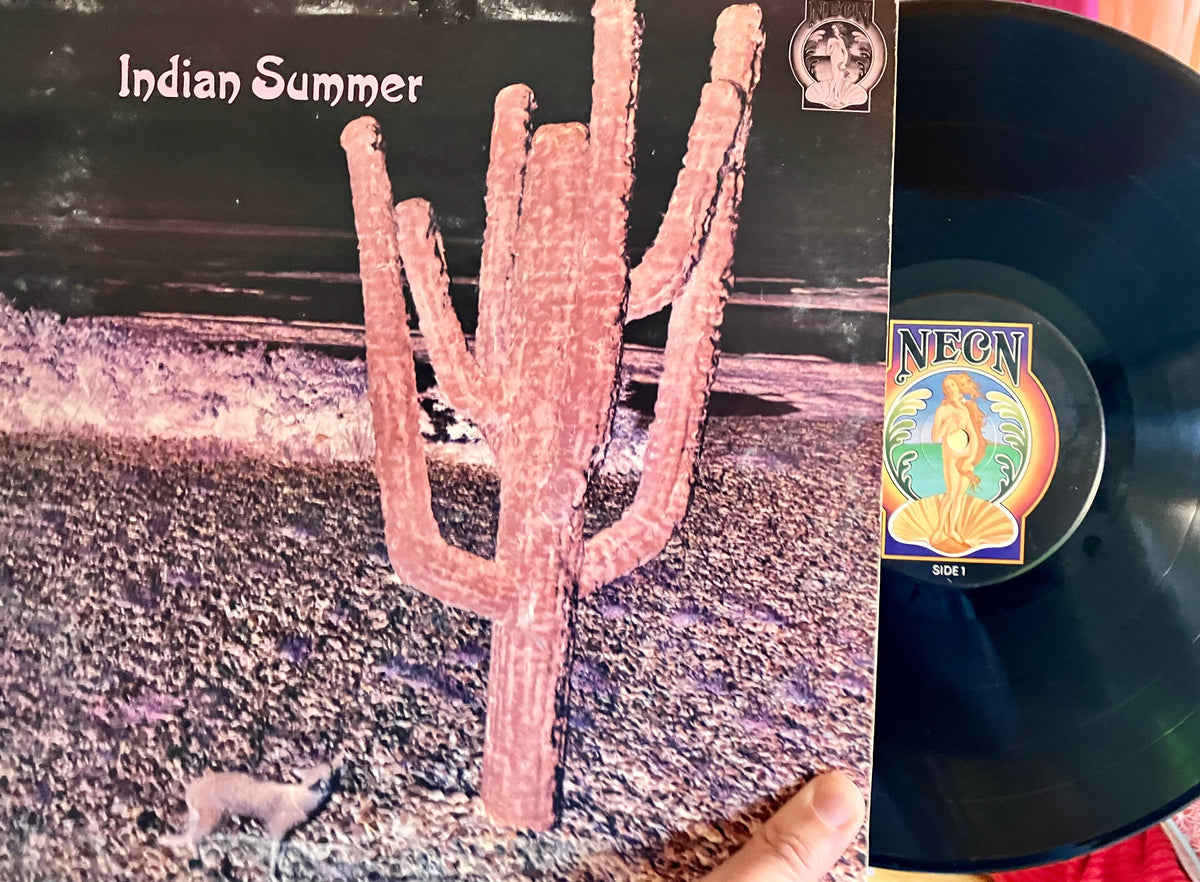
Indian Summer A Forgotten Supergroup from Coventry
There are albums that make you wonder how on earth they managed to pass almost unnoticed when they were first released. Records that seem to have everything we associate with the most creative period of British progressive rock, around 1970–1972. Indian Summer’s self-titled album from 1971 is most certainly one of them.
The story begins in Coventry in 1969, where Indian Summer emerged as an increasingly interesting name on the British rock scene. But there is a rather more fascinating story behind the band than simply another progressive rock album from the period.
In the Shadow of Black Sabbath
At the time, there was a relatively small but hugely significant musical world centred around Birmingham and Coventry. One of its key figures was Jim Simpson, the man who helped bring Black Sabbath to prominence. He ran Henry’s Blues House in Birmingham, a venue that welcomed many of the most interesting bands of the day. Among them was Earth, the band that would soon become Black Sabbath.
Indian Summer came into contact with Simpson through the local club circuit. He recognised the potential in the group and also brought along Olav Wyper, who was then working for Vertigo Records, to see them. What makes the story particularly interesting is that Simpson and Wyper had seen both Indian Summer and Black Sabbath performing within the same musical circles.
When the time came to sign a band, it was Black Sabbath who secured the record deal with Vertigo. Indian Summer would have to wait.
But that was not the end of the story. After a further period of intensive gigging, the Coventry band had developed considerably. Wyper had since moved on to RCA, where he was establishing the progressive label Neon Records. Simpson once again took Wyper to see Indian Summer, and this time the meeting led to a recording deal.
There is also a wonderful little episode in which Bob Jackson and Malcolm Harker were invited to Ozzy Osbourne’s home to discuss whether Indian Summer might join the same management stable as Black Sabbath. Two bands moving in the same circles, yet destined for very different futures.
It is difficult not to wonder how differently things might have turned out for Indian Summer. While Black Sabbath would go on to write their name into rock history, Indian Summer never really got the opportunity to fulfil their potential.
An Album That Deserved So Much More
In 1971, the band’s self-titled album was released on RCA’s Neon Records, with Rodger Bain in the producer’s chair. Bain had already worked with Black Sabbath by this time. The result was a beautifully crafted recording, especially considering how little time the band had spent in the studio.
What makes Indian Summer so interesting is that they emerged from the same musical and geographical environment as Black Sabbath, yet their sound was considerably more diverse than their brief career might suggest.
When I listen to the album, I hear several of the great musical expressions of British rock. The weighty, rolling church-like sound of the Hammond organ, the harmonic freedom of jazz, Yes-like melodic passages and sudden bursts of Black Sabbath-inspired heaviness. There are also echoes of Deep Purple and Uriah Heep, yet Indian Summer somehow manage to create something that feels entirely their own.
This is an album that constantly moves between different musical worlds. From jazz-inflected harmonies and long, floating melodies to powerful guitar riffs and a Hammond organ that at times seems to carry the entire sound. There is a wonderful musical fluidity to the arrangements and a melodic sensibility that ensures the music never feels contrived or overworked.
A Story That Ended Far Too Soon
Despite the strength of their debut, commercial success failed to materialise. Record sales were modest, financial difficulties began to mount and plans for a second album gradually fell by the wayside. A proposed single featuring Walking on Water and Firewater was never released either. Following further changes in the line-up and continuing difficulties, the band eventually called it a day in 1972.
All that remained was a single studio album and a story of what might have been.
In my opinion, this is one of the finest albums released during that period. It is a truly outstanding example of just how creative and boundary-pushing British rock music could be between 1970 and 1972. The fact that Indian Summer never achieved considerably greater success is, to me, almost inexplicable.
Perhaps that is precisely why the album feels so special today. It is not simply a forgotten record from a bygone era, but a musical work that still has the power to surprise and fascinate.
And above all, it is an album that deserves to be played, not just collected.


