

When I was very young, around six or seven years old, I used to lie on the living-room floor listening to records my mum would play. Our home had a distinctly 1970s-inspired feel. My dad worked with flooring and carpets, so rugs seemed to be everywhere. In the living room, in particular, there was a thick, pale, pure-wool tufted rug with a very long, shaggy pile. It was like lying on a sheepskin.
I especially loved lying there listening to soul, without really knowing that this was what the music was called. We listened to Marvin Gaye’s What’s Going On, Stevie Wonder’s Music of My Mind, Barry White’s I’ve Got So Much to Give, Aretha Franklin’s Young, Gifted and Black and Diana Ross’s Surrender, to name just a few.
Isaac Hayes, on the other hand, is someone I have no distinct memory of listening to back then.
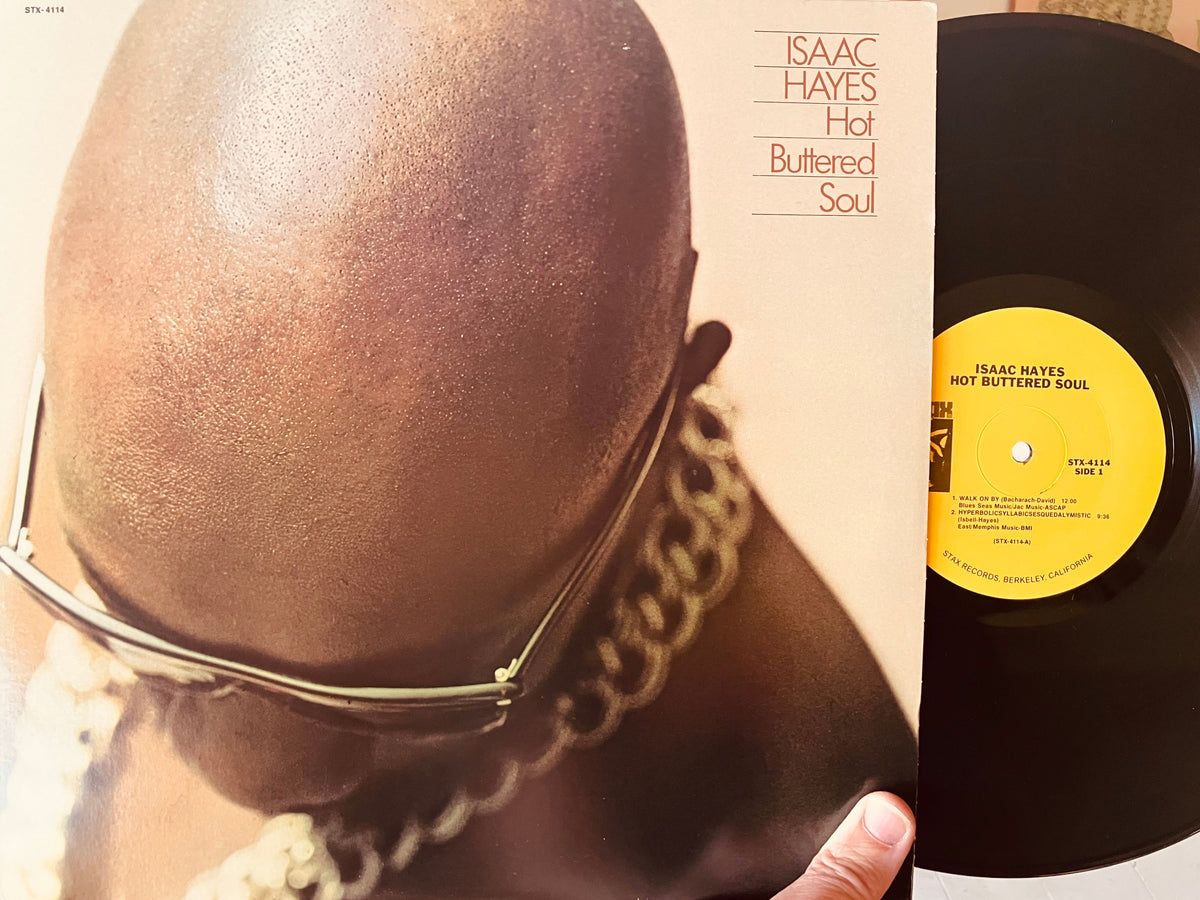
With just four tracks and a running time of over 45 minutes, Hot Buttered Soulchallenged the idea of what a soul album could sound like. Long arrangements, deep grooves, psychedelic touches and Hayes’s unmistakable voice created something that was both cinematic and intensely intimate.
Yet there was one track that had been hovering at the edges of my mind, never quite rising to the surface. A track just over nine minutes long, with the decidedly peculiar title Hyperbolicsyllabicsesquedalymistic. I had a vague recollection of listening to a babbling female voice as a child, almost like a jumble of words, all merging into one rhythmic stream.
Then, one day, I spotted a copy of this LP while flicking through a record crate. On some subconscious level, I knew this was a really good record. I pulled it out and, much like the critic in Ratatouille, experienced one of those extraordinary back-to-the-past moments. A taste, a smell or, in this case, a few notes of music can suddenly unlock something you thought you had forgotten.
Hot Buttered Soul feels like a bridge between spoken rap, musical theatre and – at its very best – psychedelic prog rock, funk and soul, all served up as a perfectly mixed cocktail in which each ingredient retains its own distinctive character.
Isaac Hayes combines the emotional weight of soul with deep basslines, heavy drums and funk’s long, repetitive grooves. He allows the music to take its time, grow and constantly change shape, without ever losing its driving momentum.
This is particularly evident in Hyperbolicsyllabicsesquedalymistic. Here, the rhythm and hypnotic pulse lean towards funk, while gospel, orchestral soul and psychedelic elements weave their way into the mix. The result is music that both swings and floats – almost as if it exists in a world of its own, somewhere between a concert, a theatrical performance and a musical dream.
If you haven’t really explored soul music before, start here. It is a wonderfully intriguing listening experience, and an album I can wholeheartedly recommend.


