

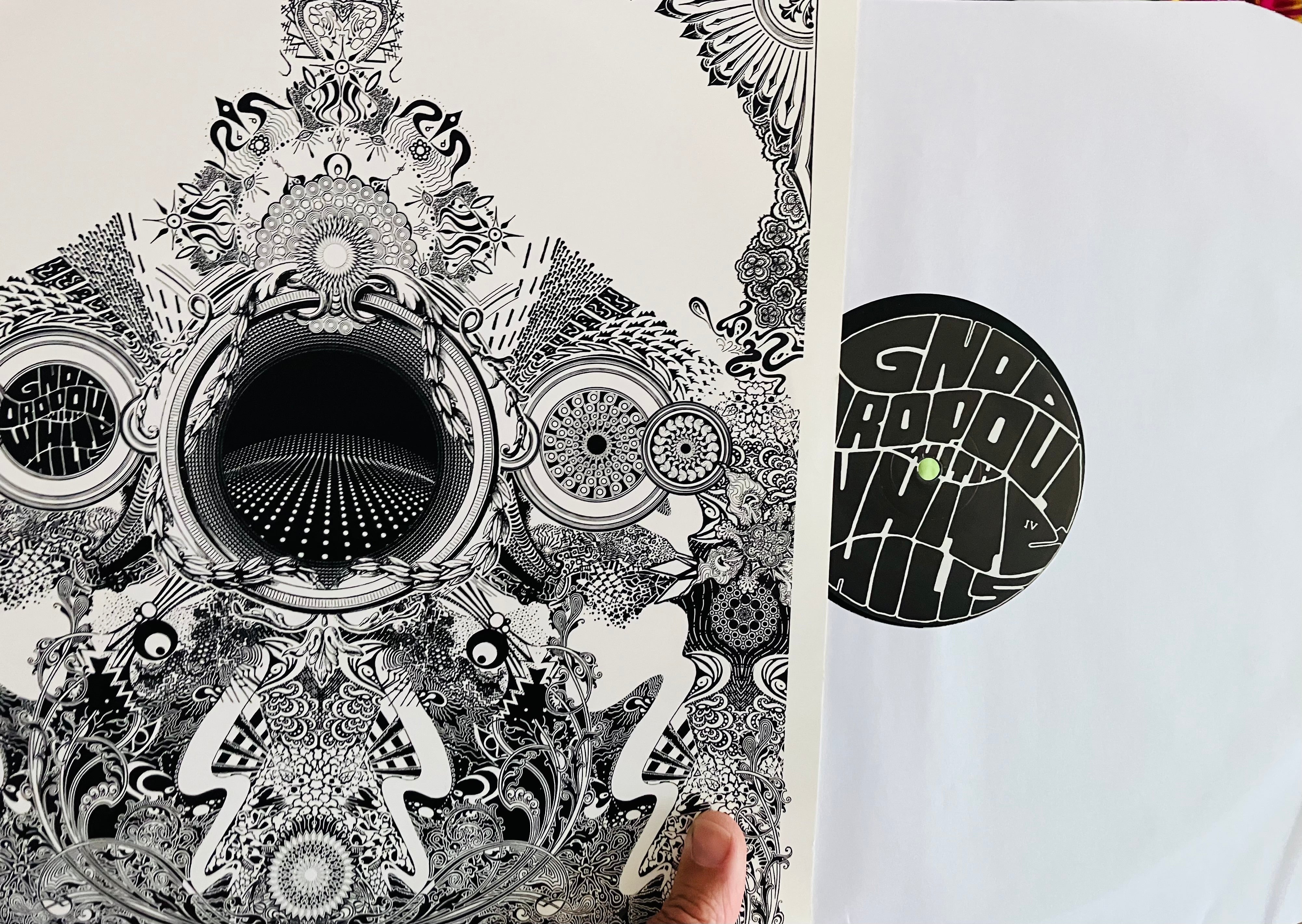
This time I simply couldn't resist choosing an LP that holds a particularly special place in my heart – Gnod Drop Out With White Hills II by GNOD – and once again using it as the starting point for a deeply personal memory. The music itself is superb, without question, but what I really want to tell you about is what happens to me every time I take this record from the shelf, turn it over in my hands and let the music pour from the speakers.
This story takes us back to 2010 and the very first Supernormal Festival at Braziers Park in Oxfordshire. Supernormal grew out of the International Artists' Workshop (IAW), an initiative founded by artists Gill Ord, Bernadette Moloney, Andy Cohen and Simon Faithfull, which was also based at Braziers Park. In its early years it was simply known as the Braziers Workshop, an event I had attended on several occasions ever since its takeoff in 1995. It is also worth mentioning that WOOD Festival, launched in 2008, emerged from exactly the same creative environment, driven by many of the very same people.
I remember being genuinely excited. I'd arrived at Braziers a couple of days early to help with the final preparations before the festival opened. That meant everything from finishing the outdoor compost toilets to marking out the footpaths and boundaries across the festival site. I had noticed GNOD on the line-up but knew very little about them. People kept telling me they were excellent, and that they had released a new LP earlier that year which had been receiving glowing reviews. The evening GNOD were due to take the stage was grey and overcast, with a light drizzle hanging in the air. You know that peculiar effect when you squint towards the stage and the lights catch the rain, making every single droplet suddenly visible? Everything became slightly blurred, like looking into a world of moiré, almost as though I were peering through a camera lens filled with bokeh. Of course, there was beer and jazz in the mix as well, seductively heightening the whole sensory experience.
GNOD took to the stage ahead of Faust, Saturday's headline act, on that cool evening of 21 August 2010. Many of us were lying there in the soaking wet grass, staring up at the sky, wrapped in a warm, vibrating blanket of rhythmic sound. I learned later that one review described the performance as "brain crushingly brilliant", and to this day I can't think of a more fitting description.
The festival is remarkable not only because it feels like a direct descendant of the late 1960s, but above all because everyone genuinely shares accommodation with the very artists who are performing. Everything exists within the same festival grounds. Tent is therefore the very essence of the experience – come rain or shine. And this time, very much rain.
After the performance I stumbled down towards the stage area and immediately found myself face to face with, as I remember it and still believe today, a completely drunk Chris Haslam. (Some band members use invented names, such as Neil the Fish, which makes it difficult to know exactly who was who afterwards.) Chris was the one playing keyboards and synthesizers in the band at that time.
I expressed my feelings in much the same way that I remember him embracing them – with a great deal of warmth, affection and loud, euphoric enthusiasm. I distinctly remember him hugging me. Somewhere in that haze, in the middle of the swirling moment, I may have stretched the truth slightly. Wanting to preserve and honour the momentum of our connection, I blurted out that I was a huge fan and that I had travelled all the way from Sweden specifically to see them play. Faust, I explained, were not my main attraction. I can still picture his reaction, a mixture of surprise and pride. Chris put his arm around me and said that this was something he absolutely had to tell the other band members. And so we did. We made our way over to a cluster of GNOD musicians who, surrounded by a group of friends, were standing in the middle of a lively party gathering. At the time I was wearing a long kaftan, embroidered with beads and gold thread. My hair was loose, long, and accompanied by a beard. On my feet were a pair of open leather sandals. The overall effect placed me considerably closer to a wandering Jesus figure than your average festival-goer. I was received almost like a mascot and guided around among the band's friends and members of other groups. It was as if they wanted to show me off: "Look at this – our fan has travelled all the way from Sweden." There was a warm, playful pride in their voices, almost as if they were wondering whether the other bands could boast of having fans who had travelled such a distance. Within this kaleidoscope of soundscapes spilling over from the other stages, shimmering lights, loud cheers, muddy sandals, soaked clothes, jazz tobacco and alcohol, that strange state of intense intoxication and euphoria began to take hold – where everything swirls around in a haze and neither sight nor thought remains entirely clear. Time lost its shape, and all impressions merged into one continuous blur. And right in the middle of it all, almost as if conjured by magic, an LP record and a black permanent marker appeared. Naturally, the lad was going to get a signed copy.
To describe Gnod Drop Out With White Hills II is like trying to capture a bank of fog with your bare hands. The music moves slowly but relentlessly forward, built upon hypnotic rhythms, grinding basslines and guitars that gradually dissolve their own contours into a sea of echo and distortion. Everything is built around repetition, but never repetition as monotony. Instead, the repetition becomes a mantra. The longer you listen, the less you distinguish the individual instruments, and the more you are drawn into a single, organic current of sound. Yes, you get it. This is the perfect record for that particular feeling of dropping the corner flag, surrendering completely and entering a state of total exception, with the naïve hope that by morning everything will somehow be forgotten. The album is not psychedelic through showmanship or bursts of colourful experimentation, but through a near-obsessive endurance. GNOD and White Hills remain locked into a groove until it ceases to be a groove and instead becomes a mental space. The music does not drive towards a climax – it circles, breathes and loops back into itself. The result evokes ritual music, drone and the endlessly humming machinery of early krautrock just as much as it does rock music in any traditional sense.
If you have a weakness for this kind of music, I would go so far as to say this record is a complete no-brainer – an absolute must.


